Illuminate Your Adventures
- Rugged, Bright Off‑Road Lighting Solutions
- Conquer the Night on Outback Roads
- Built for Australia’s Harsh Conditions
Summary
LED driving lights are powerful auxiliary lamps mounted on a vehicle’s front to supplement its headlights for night driving, especially in rural or off‑road conditions. Modern LED lights offer much higher brightness and longer lifespan than halogens, while using less energy. In Australia, LED driving lights come in different beam patterns (spot, flood, combo) and mounting styles to suit varied driving needs. This page explains what they are, their benefits, typical uses (outback touring, bush tracks, work sites), legal requirements (national ADR rules and state laws), buying considerations (beam type, ingress rating, lumens, compliance, warranty), installation tips, and a brief FAQ.
What Are LED Driving Lights?
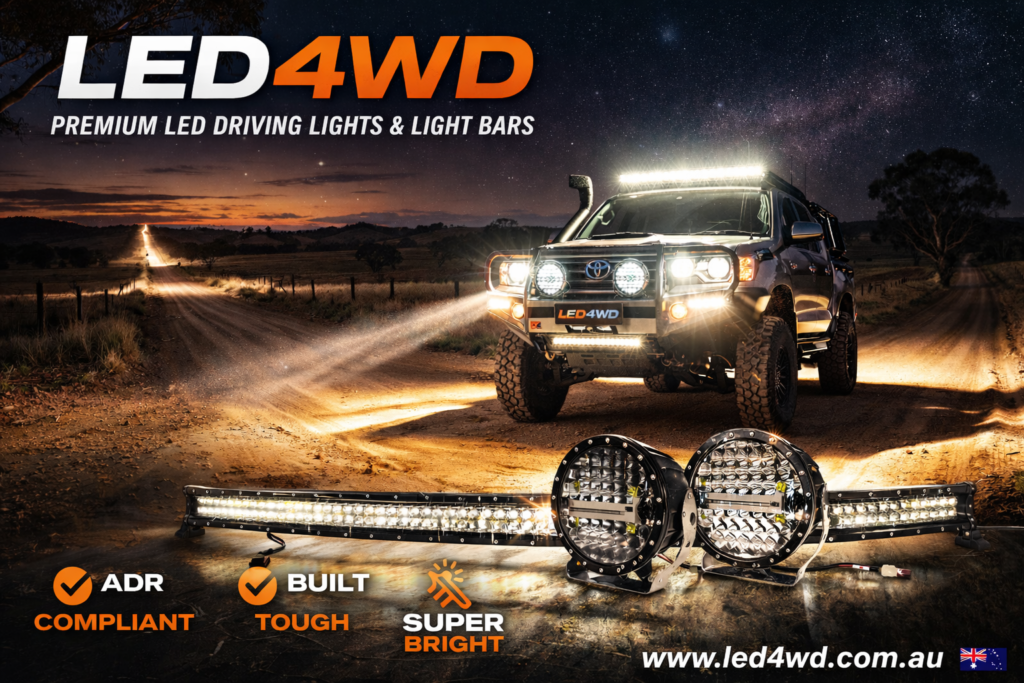
LED driving lights (also called auxiliary driving lamps) are aftermarket forward‑facing lamps that supplement a vehicle’s headlights for improved visibility. They use Light Emitting Diode (LED) sources, which produce intense white light and can be very compact. Unlike factory low‑beam or high‑beam headlamps, driving lights are designed to throw light far ahead or widen the illuminated area. Typical units include round spotlights (narrow beam), rectangular light bars (wide beam), or combo lights combining both. Driving lights are usually mounted on bull bars, bumpers, roof racks or pillars, and wired into the vehicle’s high‑beam circuit so they only operate on full beam.
Key Benefits of LED Lights
- High Brightness & Range: LEDs can deliver very high lumen output for long-range and wide‑area illumination. High‑quality LED lamps can cast one lux of light nearly a kilometer away in tests. They significantly boost visibility compared to stock headlights.
- Energy Efficiency: LED lights draw far less power than halogen or HID lamps, reducing battery/alternator load and heat. This efficiency can slightly improve fuel economy and minimize electrical strain on the vehicle.
- Longevity: LED driving lights last tens of thousands of hours (often ~30,000–50,000+ hrs), far longer than halogen bulbs. In practical terms, you’ll replace LED units far less often, saving maintenance cost.
- Durability: LEDs are solid-state with robust housings. Good LED driving lights are vibration‑proof, shock‑resistant and sealed against dust/water (typically IP67 or IP68 rating). They withstand rough off‑road use and harsh environments better than fragile halogen glass bulbs.
- Beam Options & Mounting: LEDs allow flexible designs. You can get narrow spot beams, wide flood beams, or combination patterns (see table below) to suit driving style. They’re available in many sizes (5″, 7″, 9″ round spots or long bars) and can mount on bull bars, roof racks, A-pillars, etc. (subject to legal limits). Many LEDs also have built‑in spreads or diffusers for customization.
Common Use Cases in Australia
- Outback Highways: On open, unlit roads (e.g. in the Outback or rural highways), long‑range spot beams help drivers see animals or obstacles far ahead. Combining spots and floods in a bar gives both distance and peripheral light.
- Bush and Off‑Road Trails: In dense bush or forest tracks, wide‑angle flood beams illuminate trees, ditches and terrain close around the vehicle, improving reaction time in tricky conditions. A light bar or wide combo lamp helps navigate trails safely at low speed.
- Rural and Farming Use: Farmers and graziers use LED driving lights on utes and tractors to light up paddocks and work areas after dark. The bright, stable LED glow improves night work (e.g. mustering stock, loading) and increases visibility to others.
- Worksites and Emergency: Utility vehicles, tow trucks, and emergency vehicles often fit LED light bars for scene lighting. The broad flood spread is ideal for illuminating work sites or camps, and LEDs won’t overheat after long use.
These lights reduce driver fatigue and spot hazards sooner on dark roads. In remote Australia, quality lighting is one of the most popular 4WD upgrades for safety.
Legal and Safety Guidelines
Australian Design Rules (ADRs) and state traffic laws regulate auxiliary lights. Key points:
- ADR Compliance: All LED driving lights used on-road must meet ADRs (e.g. ADR13/00 for installation, ADR46/00 headlamps, ADR101/00 for LED sources). Only white light is permitted. Aftermarket “off-road only” lamps are generally not ADR-approved and are not legal on public roads. Always choose ADR-certified driving lamps.
- Lamp Color: By law, additional driving lights must emit white light (no colors or tints).
- Number of Lamps: Typically a maximum of four additional forward‑facing driving lamps is allowed per vehicle. An LED light bar counts as one lamp if all its LEDs operate together. (If it has independently controlled sections, each counts separately.)
- Wiring/Operation: Auxiliary lamps must be wired to the main high beam circuit so they only operate when the high‑beams (main beams) are on, and switch off when you dip to low beam. In other words, you cannot legally use driving lights on low beam or alone.
- Mounting Position: Lights should be symmetrical and as low as practical on the front of the vehicle (e.g. below bonnet line). They must not be mounted on top of a bullbar above the bonnet or protrude beyond the front bumper (to avoid injuries). Roof‑rack bars are permitted only if they do not dazzle the driver. Always aim lamps straight ahead or slightly down to avoid dazzling oncoming drivers.
- Dazzle and Safety: All lights must be aimed and fitted so they do not dazzle other road users. This usually means setting the beam level at or below horizontal, and checking alignment after installation. Avoid overly bright retrofitted bulbs in standard housings – these often cause glare and do not guarantee ADR compliance.
- State Variations: Some specifics vary by state/territory. For example, Queensland’s vehicle standards allow 4 lamps and forbid “protruding” lamps on bullbars, while the NT also specifies centre‑mounting for light bars. Always check the latest rules for each state. In general, ADR compliance and high-beam‑only operation are nationwide requirements.
Quick Legal Checklist
| Item | Typical Requirement | Action/Tip |
|---|---|---|
| Lamp Color | White only (for driving/flood lights) | Use white LEDs; remove any colored lens covers. |
| Maximum Lamps | Up to 4 additional lamps | Count each lamp; ensure combined count ≤4. |
| Wiring & Operation | Operates only on high-beam | Wire through high-beam circuit; no manual override. |
| Mounting Position | Front of vehicle, symmetric, < bonnet height | Mount lights low (e.g. under bullbar, on roof front), evenly spaced. |
| Beam Aim | Level or slightly down (avoid glare) | Aim lights so main beam stays on road (per road regs). |
| Certification | ADR-approved lamps (ADR 13/00, 46/00, 101/00, etc.) | Use only ADR-certified driving lamps; “off‑road” only units are illegal on-road. |
Buying Tips
- Beam Pattern (Spot/Flood/Combo): Choose based on how and where you drive. Spot beams have a very narrow, focused beam for long distances; flood beams produce a wide, short‑range spread; combo beams mix both. See comparison table below.
- IP Rating: Off‑road lights should be at least IP67 (dust-tight and water-proof to 1m) or IP68. This ensures they survive rain, mud and dust. Modern LED bars often come IP68.
- Light Output: Look at lumens or lux. A higher lumen/lux means brighter output (some premium lights list effective lumens). Also consider CRI (Color Rendering Index) if you need better color visibility (e.g. for work lamps), though most driving lights are ~60–70 CRI white.
- Housing and Build: Sturdy aluminum housing and polycarbonate lens are common. Seek features like cooling fins and strong brackets. Waterproof connectors and a sealed wiring loom are a plus.
- ADR Compliance: Verify the light (or its LED module) is ADR-approved for on-road use. Many driving lights explicitly state “ADR-approved” or “ECE R112 approved”. Avoid cheaper “off-road only” imports if you plan to use them on public roads.
- Warranty and Brand: Reputable brands often offer multi-year warranties (2–5 years). Warranty length can be a quality indicator. Consider Aussie brands (Lightforce, ALTIQ, Rigid, SPOT) or big import brands with local warranty coverage.
- Price vs Quality: Higher output and durability often come at higher cost. Balance budget with longevity needs (e.g. heavy use off-road might justify premium lights).
Spot vs Flood vs Combo Comparison
| Beam Type | Purpose | Beam Distance | Beam Width | Best Use |
|---|---|---|---|---|
| Spot | Long-range visibility | Very long (100s of m) | Narrow (focused) | High-speed open roads, touring; spotting distant hazards |
| Flood | Wide-area illumination | Short to medium (tens of m) | Wide (broad swath) | Off-road trails, bush tracks, low-speed navigation and work sites |
| Combo | Versatile mix of both | Medium to long | Medium (combined) | Mixed driving conditions; both on- and off-road; common 4WD upgrade |
Installation & Maintenance
- Mounting: Use proper brackets and fasteners. Auxiliary lights should be bolted to a rigid surface (bull bar, roof rack cross‑bar, bullbar wings, etc.) that meets legal height limits. Avoid dangling or vibrating mounts.
- Wiring: Install with a relay and fuse in line to the battery. Many kits include a harness. The wiring should trigger only on high beam (often by tapping into the high beam circuit or using a harness with a “trigger wire”). Ensure the switch, fuse, and relay are correctly rated for the lamp’s current. A qualified auto electrician is recommended to guarantee compliance and safety.
- Alignment: After installation, aim the driving lights so the beam is level or slightly downward. Typically, you mount the vehicle 3–5m from a wall, switch on the lights, and adjust tilt so the brightest spot of the beam is just below the wall’s center. This prevents blinding oncoming drivers.
- Maintenance: Keep the lens clean of mud and dust to maximize output. Check mounts and wiring periodically for corrosion or looseness. Replace LEDs only with compatible, approved units if necessary. Because LEDs last so long, bulbs rarely need swapping, but the wiring and lenses should be inspected.
FAQ (5 Questions)
- Q: Are LED driving lights legal on Australian roads?
A: Yes – if they are ADR-approved and fitted correctly. They must be white, wired to high beam, and used only in the conditions allowed (no oncoming traffic). In practice, using LED spotlights or bars on unlit rural roads or off-road is common and legal when done per the rules. Always ensure any additional lights comply with ADRs and local regs. - Q: Can I replace my stock headlights with LED bulbs?
A: Only with ADR-approved conversion kits. In many cases, simple LED “bulb swaps” for halogen headlights are NOT ADR-certified for road use, so they can fail inspection. For driving lights, it’s better to buy complete ADR-approved LED driving lamps rather than retrofit a headlamp with an aftermarket LED. - Q: How many auxiliary driving lights can I fit?
A: Typically up to 4 additional lamps (aside from the vehicle’s standard high beams). For example, you can have two spotlights and one LED bar (the bar counts as one). Always check specific state/territory limits, but four is a common national cap. - Q: How do I aim/install them safely?
A: Mount lamps symmetrically and low (e.g. on the bull bar, bumper or roof crossbar within legal height). Aim them straight ahead or slightly down to avoid dazzling others. It’s wise to have a professional align the lights by marking their pattern on a wall from a set distance. Following installation guides or state-VSI instructions helps ensure compliance. - Q: When should I turn them on?
A: Use LED driving lights in dark, unlit conditions – e.g. at night on open highways, dirt roads or when off-roading. They should be OFF when there are oncoming or preceding vehicles (to avoid glare). In rain/fog, flood beams can help, but generally headlamps (or fog lamps) are better for very poor weather. Always switch them off when any oncoming traffic is near or when legal conditions require.
Ready to Upgrade?
LED driving lights are a smart investment for safer night driving in Australia. If you’re exploring or working in dark conditions, choose quality ADR-compliant LED lamps from LED4WD – Australia’s 4WD lighting specialists. Visit LED4WD.com.au to browse top brands (Lightforce, Stedi, Rigid, etc.) and find the perfect driving lights for your vehicle. Drive safer tonight with LED4WD.
Meta Title: LED Driving Lights Australia – Benefits, Uses & Legal Info | LED4WD
Meta Description: Learn about LED driving lights in Australia: definition, benefits (brightness, efficiency), legal rules, use cases, buying tips and FAQs. Stay safe off-road with LED4WD.com.au.